
Speaker Topics
The Unthinkable: The Medical Suppression of Incest—Then and Now
This presentation exposes strategies employed by medical professionals to keep incest from public view and to erase incest from the historical record. The social and political consequences of the suppression are also addressed.
Why We Need to Repoliticize Sexual Violence
In this presentation, Dr Osborn examines how the medical establishment—functioning as an extended patriarchy—has depoliticized and coopted the issue of sexual violence.
Sexual Violence Against Girls and the Politics of Shame
In this talk, Dr. Osborn reveals how enduring systems of private, institutional, and political power cultivate feelings of shame and helplessness in victims, undermining collective political mobilization.
What’s in a Word? Re-Visioning the Language of Sexual Violence
Too often, we still rely on euphemisms, stereotypes that favor perpetrators and show skepticism towards victims, and, sensationalism. Dr. Osborn’s presentation highlights examples of this language and offers clear, constructive alternatives.
Selected Lectures, Presentations, & Workshops
Unthinkable: The Medical Suppression of Incest Then and Now
Incest Aware
During this presentation, I spoke about the strategies employed by past and present medical professionals to keep incest from public view and to erase incest from the historical record. The social and political consequences of the suppression were also addressed. I concluded with remarks about how we can use this knowledge to help combat internalized oppression, help medical professionals be with their patients, and empower more effective action strategies going forward.
How Come Nobody Talks About Incest and Why it Matters to You: A New Way of Empowering Action
Student Organized Consent Conference, Seattle WA
This presentation focused on suppression tactics used in the past to silence and marginalize women who have experienced sexual violence. We also discussed how we can use our knowledge of the past to effectively strategize ways of dealing with present challenges.
Contemporary American Fiction: Styles of Engagement, in conjunction with a reading of Surviving the Wreck
Universität Basel, sponsored by The British Society for Literature and Science
Because Bowen’s writing style challenges our conventional reading expectations in ways that sometimes parallel those used by feminist activists to disrupt traditional expectations of women, I used this presentation to explore the imaginative and social value of these disruptions. After, I read passages from my novel about incest, Surviving the Wreck.
A Problem and a Wonder: Developing Students’ Metacognitive Abilities in the Creative Writing Classroom
Northeast Modern Language Association
Young writers are often told to revise, but they are not taught how to re-vision, or re-see their writing in order to effect improvement. Using ideas gleaned from reading Adrienne Rich’s feminist essays, I outlined strategies that help students learn how to revise their thinking and writing.
‘This Pointless Verbal Excess:’ A Reconsideration of Bowen’s Stylistic Tics, ‘A Mixture of Showing off and Suspicion, Nearly as Bad as Sex’: Reading Elizabeth Bowen
Symposium, University of Sussex
In this presentation, I once again tackled Bowen’s prose and the gendered criticism that was often deployed to deride and shame her as a “deviant” and “excessive” (i.e., “neurotic”) female writer.
“Elizabeth Bowen Imagining Ireland,” in conjunction with a reading of “Lie About”
Louisville Conference on Literature and Culture
For this conference, I was asked to read some of my fiction and present an aspect of my Bowen scholarship. “Lie About” reflects the social injustices I witnessed every day when I lived in a very affluent Ivy League town. In “Elizabeth Bowen Imagining Ireland,” I spoke about the wonderful and challenging ways Bowen imagined her homeland in her prose fiction. She was not known as a feminist writer, but her syntactical disruptions often echo strategies used by feminist nonfiction writers of the ’60s and ’70s.
Excerpts from My Mother’s Shoes
Rutgers University Reading Series
Elizabeth Bowen’s Ireland
Invited lecture, Trevor/Bowen Literary Summer School, Mitchelstown, Ireland
Although married, Bowen lived most of her married life away from her husband. Bowen did not identify as a feminist. But I took this opportunity to explore the relationship between her life as an independent woman and the tangled history of Ireland.
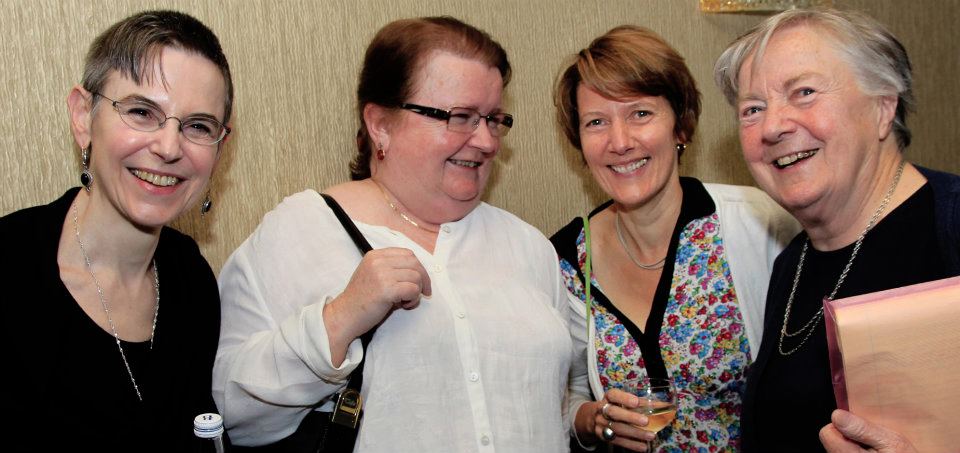
Bowen conference, Mitchelstown, Ireland