
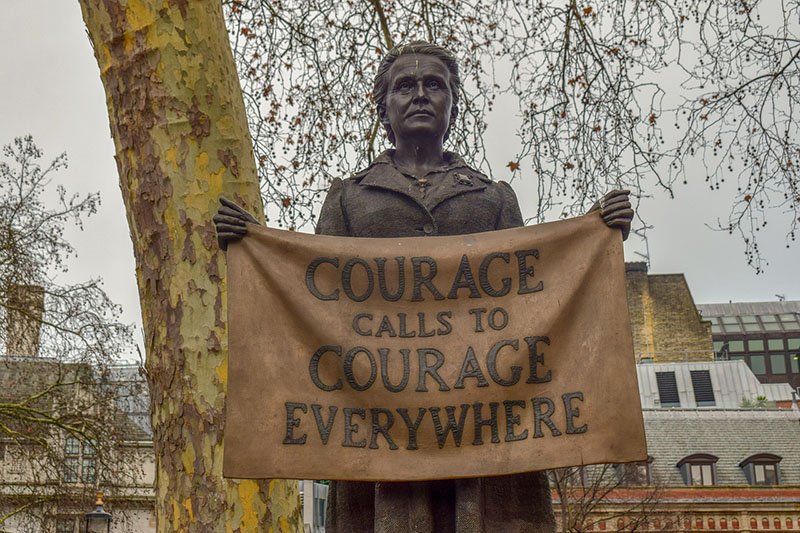
Statue of Millicent Fawcett, political activist and writer, 1847-1929.
Speaking Truth to Power
It’s true that some people become uncomfortable when they hear the word “incest” or use the word “incest.” I’ve heard it described as “icky” and “nasty-sounding,” as if the problem lies in the sound of the word itself rather than in what it names. And I suppose that when compared to many of the more scientificky sounding and syllable-crammed mouthfuls that we use today in place of “incest”—such as “intrafamilial sexual abuse”—it is. “Intrafamilial sexual abuse” has a cleanliness about it, a sterile sound that lifts it above the sordid depths of what it describes. When we hear “intrafamilial sexual abuse,” we don’t think of secret sexual violence committed by fathers (or father surrogates) against daughters; instead, we imagine something more clinical, a phenomenon that might take place in a lab.
But although these comparatively neutral and relatively anodyne terms may be easier on the ear, you simply cannot meaningfully confront sexual violence without naming it for what it is.
Think of it this way. Before psychologist Mary Koss coined the phrase “date rape,” acquaintance rape was rarely recognized as a crime, much less prosecuted. As Gloria Steinem once quipped, before we had language—names—to describe sexual harassment, date rape, and other forms of sexual violence against women and girls, such misogynistic and predatory behavior was often dismissed as “just life.”
I understand that for some, the word “incest” still evokes latent fears—fears about social dissolution, primal contamination, and taboo. There’s no doubt that in our culture, the word “incest” still bears a kind of frisson, an uncanny horror that both thrills and repels. But as anthropologists have shown, such outrageous fears are not natural or inevitable; rather, they have been generated by those in power to preserve social order through silence. But when working to un-silence incest, we need to always remember that the frisson, those fears, are manufactured, not natural.
For all of those reasons, it was important for me to use the word “incest” in the title, and throughout the text. As I alluded to, incest has long been—and still is—hidden behind a wall of gender-neutral and anodyne terms such as “intrafamilial sexual abuse” and “adverse childhood experiences” (ACEs). For a brief period during the early 20th century, incest was even euphemized as “a non-accidental injury,” or NAI. While these terms might be appropriate in some contexts, as our default language, they sanitize and depoliticize a crime. I chose not to use those more bleached-out terms precisely because of the kind of cultural work that they do: they soften, neutralize, and ultimately obliterate the political nature of incest. Unlike these defanged terms, “incest” is a word that speaks truth to power. Incest points directly at what is being described: a sexual violence crime committed by fathers (and father surrogates) overwhelmingly against daughters and other less powerful, younger girls in a family.
But the word “incest” does even more. The word “incest” doesn’t just name a sexual violence crime committed by fathers and father surrogates. It also exposes The Father—the patriarchal system that grants fathers (and father surrogates) license to commit sexual violence against their daughters. Unlike the less forceful terms, “incest” both names the crime and presents a serious challenge to the ideology of male supremacy that allows sexual violence against women and girls—of all kinds—to continue.
And I think that is one reason the word “incest” is avoided in public discourse—because it threatens those in power, and its use may jeopardize those who depend on their approval. That is why I deliberately chose to use it.
0 Comments